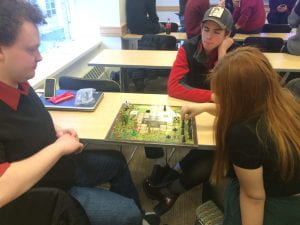
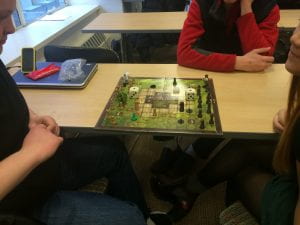
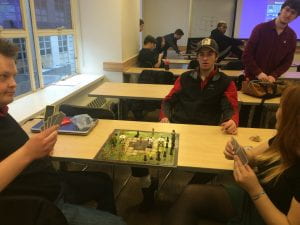
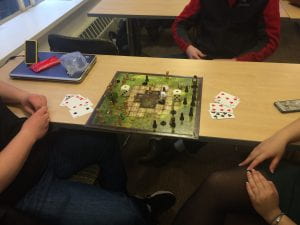
Projects

Draw Against Humanity [Appropriation]

Before you play/ Artist Statement:

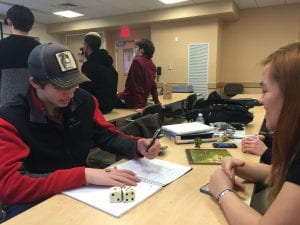
This game is a combination of two different games, “Cards Against Humanity”, and “Write and Draw”. There are a few twists to each of the game which makes this one unique and more exciting. This game is very much inspired by the Yoko Ono -esque style of having the audience getting involved with the actual process of creating the art. Additionally, it has a slight flux element to it because of the nature of the game and how it involves individual players to draw(or try to…).

Many people have played Cards Against Humanity and I’m sure that it’s been great fun, but I hope that playing it with a few twists here and there will make it more interesting for you. Although Cards Against Humanity may disappoint some players with its very horrible or offensive themes and statements, the players should try to go beyond that and think about the artistic or unartistic elements behind the white cards when playing the second part of the game.

Materials needed:

  • Cards Against Humanity Cards
  • Post it notes or something that you can stick/label the white cards from the deck
  • More post it notes (preferably large sized) for the second part of the game
  • A pencil/pen
  • Human (6,8, or 10 of them preferred)

How to Play:

Before listing out the steps of the game, here is the general flow of the game so you have an understanding of how it all goes.

  1. Divide up into two equal teams.
  2. Play 6 rounds of speed-Cards Against Humanity
  3. Put all remaining white cards into either one or two decks                                                                                         ( different difficulty levels)
  4. Play 2 rounds of Write/Draw (each team)
  5. Determine the winner

Here are the more detailed steps to playing this game. Please take note that it is important to follow all steps at all times.

  1. Grab about 80-100 white cards from Cards Against Humanity
  2. With 2-3 other members (who could play this game or not), go through each of the white cards and determine how difficult it is to draw the card.
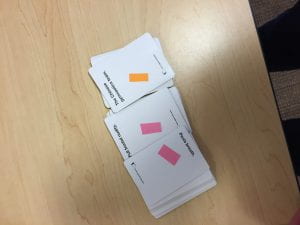
    • If the card seems relatively easy to draw, label it with yellow
    • If the card seems not too easy to draw, label it with red
    • If the card seems nearly impossible to draw, label it purple
    • If the card is impossible to draw, place in another deck far far away
  3. On a sheet of paper, write the following…
    • ” Yellow:  Point Value : 5     Seconds to draw: 25s”
    • ” Red: Point Value: 8        Seconds to draw: 35s”
    • ” Purple: Point Value: 12    Seconds to draw: 45s”
  4. Once all cards are labeled, place them into one deck and shuffle very well.
  5. Gather all players and split into two teams.
  6. Card Czar (the one who chooses with card is best) is whoever is at the end of the table on the left hand side. If you are playing at a round or other irregular shaped table, you may choose as a group as to who goes first
  7. The next Card Czar is the person to directly across the table. If playing at irregular table, go counter clockwise.
  8. Deal 8 white cards to each of the players around the table
  9. Place the remaining cards in the middle of table
  10. Explain to all players that…
    1. players may only draw one additional white card from the middle during all 5 rounds
    2. Players must place their white card in the middle within 15 seconds of the black card being placed. Otherwise the player doesn’t get to play for the round
  11.  Like a normal CAH game, let the Card Czar choose the best card. Award one point to the team of winner.
  12. Play 5 rounds of speed-CAH
  13. After 5 rounds, place all of the remaining cards in players’ hand in the middle.
    • For easy level: Place the cards in two different decks depending on which team they’re in
    • For difficult level: Place all cards into one pile
  14. The winning team will now play Write/Draw. Because they won, they get 5 additional seconds allotted for each step.
  15. Have two post it notes next to each other and a pencil ready
  16. Ask for the winning team to get in order of who is good at drawing/interpreting. Those who are good at drawing should go 1st, 3rd, 5th, 7th… Those who are good at writing should go in between them
  17. Everybody except #1 must now leave the area to where they cannot see the cards.
  18. Player #1 now chooses a white card from the deck (either their own or from the big pile) and has the allotted time written on the card to draw a visual representation of the statement.
  19. After the allotted time is over, cover the drawing with another post it note and ask for player #2 to come over. Player #2 will now have the allotted time to write what they think the player before read on the card. The post it note may be revealed when player #2 is ready.
  20. After allotted time is over, cover the drawing done by player #1 again and also cover the writing by player #2. Player #3 will now come and repeat the same process at player #1, but this time based on the statement written by player #2.
  21. Repeat steps until all players have gone.
  22. When all players have gone, all players come together and reveal the marvelous art that they have created as a group. Determine if the final drawing has anything to do with the original white card that was drawn. If it’s close, reward the team with the point value. If they have it half way there, give them half the points. If it’s horrible, don’t give them any points.
  23. Let the other team repeat the steps.
  24. Each team plays 2 times and whoever has the most points in the end wins.

Some documentation:
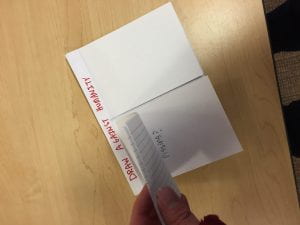
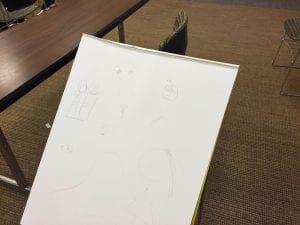
A player tried to write something...

A player tried to write something…

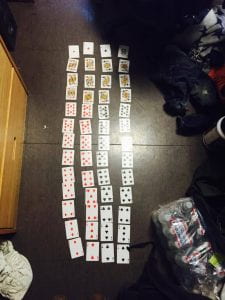
The cards labelled and ready to go
The cards labelled and ready to go

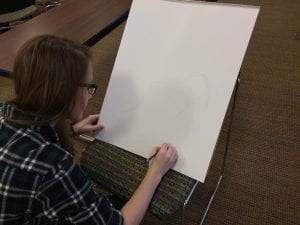
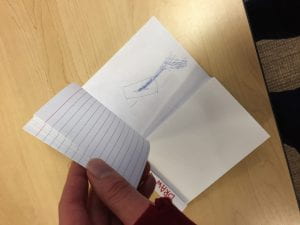
An example of a player who tried to draw....

An example of a player who tried to draw….
Chaos Mafia (Appropriate) Artist Statement [Eivind Fougner] [DRAFT]

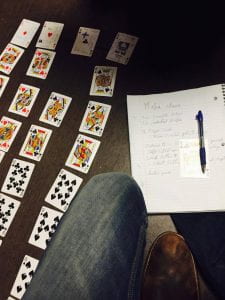
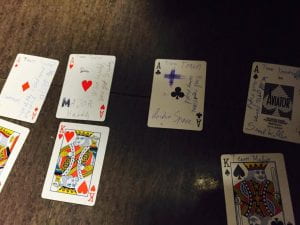
The game I have developed is called Chaos Mafia. It is very much inspired/based on the old school party game mafia, and I have also introduced many concepts from the very similar web game “Town of Salem.”  The only physical piece we use during playtime is a deck of cards which I have written roles on. The point of Chaos Mafia is the   element of complete randomness and chance – just like in real life. The game starts by shuffling the cards, and distributing one card to each player. That card provides you with your name, role, and goal for the game. I have added many different roles so the game should run differently each time (some roles: major, veteran, jester, serial killer, investigator.) From there on the format is almost identical to mafia – town goes to sleep, something happens during the night and the next day they town tries to vote on why is guilty, and that person gets hanged. Various roles have the ability to affect some of the processes however.

One of the innovating things about the dada movement is how it was one of the first movements to not focus on making aesthetically pleasing objects. In the dada movement, the point is to rather produce works that challenge the accepted norm, and make the observer/participant ask themselves questions about the art (purpose), artist (role) and society (current relevant happenings). In order to make my game dada-like, I tried do make sure that the “art” or message didn’t lie in the designed game itself, but in the random events and combinations that make Chaos Mafia so lifelike. The combination of different cards being drawn and how the story is told by the artist leads to entirely different things happening each game. Another typical thing in the dada movement is the use of everyday objects. To encompass this – all the physical material I used was a deck of cards.card1card 2card 3

Artwork 2: Appropriate: Hunger

HUNGER is a Tabletop RPG based on the Hunger Games Trilogy by Suzanne Collins.

Zip Archive of Game Material

The Zip Archive of Game Material contains the Game Manual (manual.pdf) which contains the rules and instructions for gameplay, Reference Pages (references.pdf) which contains reference material for running a game, Character Sheets (char-sheets_doublesided.pdf) which can be printed out double-sided and cut in half for use as a character sheet for Player Characters, and a sample map that could be used for gameplay (sample_map.png).

Documentation

Forthcoming after playtest. (Scheduled for the weekend of 3/5-3/6)


Artist’s Statement

This piece is an offshoot of a passion project of mine, The Hunger Games RPG, which is an online collaborative writing RPG. Many of the Tabletop RPG concepts (rolling for initiative, skill points, stat checks) haver been influenced by various Tabletop RPGs, notably Dungeons & Dragons, Pathfinder, and Paranoia. The idea of using various household objects (standard deck of playing cards, coins, index cards) was first and foremost inspired by George Maciunas’s Flux Kits, which was itself inspired by the appropriation pieces of the Dada artists.

League of LEGO (Artwork 2 Final)

Materials:

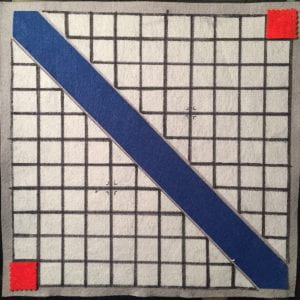
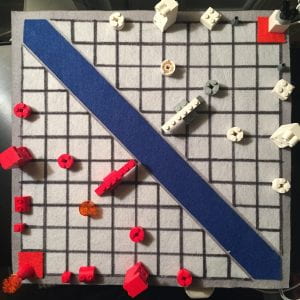
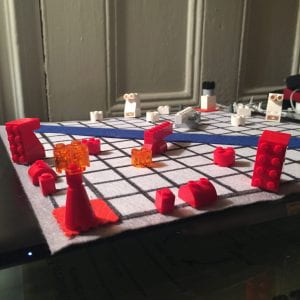
  • Arena board(self-made)
  • LEGO bricks

Rules:

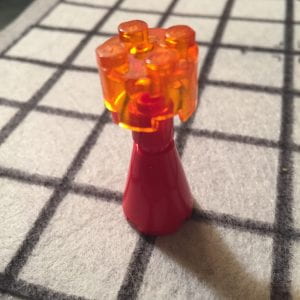
Instead of using a chess set, I decided to use several different composition of LEGO bricks as my chess pieces. All the units in this game must stand on the grid points. Players take turns and kill the enemy’s King to win the game.


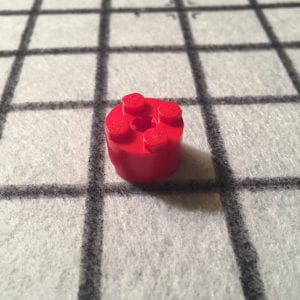
Pawn(1 HP)*4:

  • Movement Speed: 1 step.
  • Attack range: 0
  • Damage: 1

Basic troops. Pawns cannot move backward. However they can jump over allied pawns and walls( means actually 2 steps).


Captain(2 HP)*1:

  • Movement Speed: 1 or 2 steps.
  • Attack range: 0
  • Damage: 1

Leader of the pawns. They can move 1 or 2 units in each turn and can build a wall instead of “Attack”.

  • Wall(1 HP): Built by Captains. Can block the the roads and block  the attack from Canon. Exists for 1 turn.


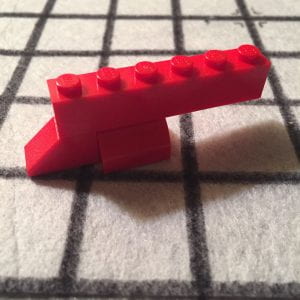
Cannon(3 HP)*1:

  • Movement Speed: No limitation along one chosen direction.
  • Attack range: No limitation.
  • Damage: 1

Cannon needs to be loaded before firing(takes 1 turn). It can fire once before the next loading process.

  • Canon cannot attack enemy directly. There must be one unit between the canon and the enemy piece that is going to be attacked (no range limitation). However the accuracy is 50%, thus the player needs to pick a card from two cards(Joker and 2). If it’s Joker, then the attack is successful, otherwise the attack is failed.
  • Pawn on canon: The accuracy is 100% (no need to pick a card).


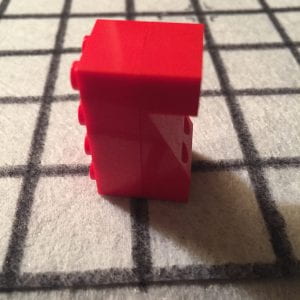
Horse(1 HP)*2:

  • Movement Speed: 1*2 area
  • Attack range: 0
  • Damage: 1

Knight(2 HP): Pawn rides on horse and becomes Knight.

  • Movement Speed: Along diagonals of 1*2 area
  • Attack range: 2*2 area
  • Damage: 1


Wizard(1 HP)*1:

  • Movement Speed: 2 steps
  • Attack range: Within 4*4 area
  • Damage: 2 dmg within 2*2 area or 1 dmg within 4*4 area

Wizard can Freeze an enemy for 1 turn instead of Attack if he crossed the river.

Player needs to pick a card from 2 and Joker. If it’s Joker, the attack is successful, otherwise the attack is failed.

Wizard can also sacrifice himself to summon a huge fireball within his attack range, which is an area splash that can destroy anything within a 2*2 area. (Fireball cannot land in the King’s area).


Bishop(1 HP)*2:

  • Movement Speed: Any steps diagonally (cannot cross river)
  • Attack range: 0
  • Damage: 1


Guard(1 HP)*2:

  • Movement Speed: 1 step along the lines or diagonally within the King’s area.
  • Attack range: 0
  • Damage: 2


King(1 HP)*1:

  • Movement Speed: 1 step along the lines or diagonally within the King’s area
  • Attack range: 0
  • Damage: 2

Pictures:

IMG_2133

Arena Board

IMG_2142

Arena board set up

IMG_2137

Pawn

IMG_2138

Horse

Cannon

IMG_2140

King

IMG_2141

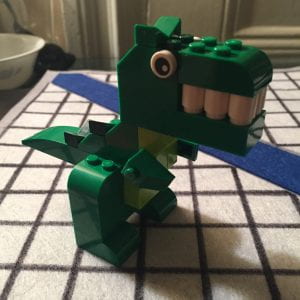
Dinosaur (not part of this game)

IMG_2143

Let’s start!


Artist Statement:

Some people thought DADA movement  was an anti-war movement however its oppositions thought it was actually the cause of the WWI. Thus whenever I thought about DADA, “war” is always the first word comes up in my mind. How can I include the concept of war into a game? My answer is chess. The original idea of the game comes from Marcel Duchamp, who had made a lot of artworks about chess. Those fantastic artworks and unlimited creativity destroyed the boundary of my thinking on chess. After the studying on Marcel Duchamp and the book The Art of Chess, I believe that the chess actually does not need to stick to its earliest form. We can do as many modifications as we want to make it more interesting. That is how the idea of LEGO chess came up.

This game includes several appropriations from other games. In the first iteration I appropriated idea from Mondrian Paintings to make a puzzle, however after the playtest I found that it was not as interesting as I thought before, but I like the idea of “purity” that comes from the Mondrian Paintings.Thus I decided to use primary colors to make the arena board. The layout of the arena is inspired by the mini map in the online game League of Legends, and the playing method is inspired by Chinese chess. My favorite part of Chinese chess is the cannons. They cannot attack the enemy directly because the cannon needs a holder to support the barrel of the cannon. It is pretty interesting that it makes the game more like a real war. Thus I decided to add this weapon to the game and let the plays to be able to apply ranged attack. Meanwhile, since the ranged attack is powerful and safe, some limitations such as the “pick-a-card” mechanism is set up. This mechanism also adds unstable elements to the game to make the game more realistic .

Also I found Yoko Ono’s White Chess very fascinating that it makes the chess super complicated and full of chaos. Since the chess pieces in the League of LEGO are LEGO bricks, if you are confident enough you can use the bricks in the same color to make the game much more challenging.

Chess is such a classic game with great fun, I love playing chess while seeking for some ways to make it even more interesting. Here comes this game and I hope everyone can enjoy.


Artwork 2: Appropriate – FINAL

Walker Albinson

Artwork 2: Appropriate

For this assignment I created a playable game that embodied the principle of the “Gamblers ruin” theory. Gamblers ruin, according to Wikipedia, is the idea “that a gambler who raises his bet to a fixed fraction of bankroll when he wins, but does not reduce it when he loses, will eventually go broke, even if he has a positive expected value on each bet” (Wikipedia.org). I chose to base my game off of this idea for two main reasons: The first is because of how the Dada movement was largely in response to WWI and alludes to the idea that people are simply players in a losing game. The second is because of how artist Hans Arp would often incorporate an element of chance into his art, which went against the traditional idea of planning and completing a work of art. My game only requires two players, two dice, a coin, and a scoring sheet, which also incorporates the Dada practice of using readymade, or found, objects to create art.

The rules of my game are fairly simple. A scoring sheet is included which should be used as a reference for the rounds. Gamblers ruin is a two player game that requires one player with a fixed bankroll to bet on coin flips against a “house” player with an unlimited bankroll. A round consists of the player making a bet on a coin flip and then either winning or losing to the house. The player’s bet must be at least 30% of their bankroll, but can be higher if they choose. For simplicity, round bet to nearest whole dollar. After five rounds of betting, there is a dice round where both players roll a six sided die with no bet. If the two faces of the dice add up to seven, the player’s bankroll is reset to its original amount. If the faces of the dice match, the player becomes the house and the game is over. If the dice do not match or add up to seven, there is no impact and the game continues. In the event that the player loses all their money, they have lost and must publicly do the “whip, nae nae” pop culture dance.

Round Bankroll Bet Outcome
1
2
3
4
5
Dice Round
6
7
8
9
10
Dice Round
11
12
13
14
15


Documentation:

*I played as the house in this game.

Round Bankroll Bet Outcome
1  500  150 L
2  350  150 W
3  500  150 W
4  650  195 L
5  455  195 L
Dice Round  260  N/A 5, 1
6  260  195  W
7  455  195  L
8  260  195  L
9  65  195  L
10  LOSS


IMG_1575

Final Iteration – Artwork 2 – Diplomatic Deathmatch


Diplomatic Deathmatch


Starting Materials:

Nerf Guns

A deck of 52 playing cards

Index Cards (for rules)


Rules

  1. Four players sit around a table with a deck of cards and two guns
  2. Each player draws a card and does not show it to other players
    1. Diamonds = Russia
    2. Hearts = France
    3. Spades = Germany
    4. Clubs = America
  3. Each suit has its own win conditions
    1. Diamonds = Win if Germany and America are killed
    2. Hearts = Win if they’re the first to be killed or are the last to survive with Russia or America. If there are more than one French players and one is first to be killed, only they win.
    3. Spades = Win if all non-Germans are killed
    4. Clubs = Win if Germany and then Russia are killed
  4. If a player wants to reveal who they are without taking the gun, all other players must agree to reveal who they are as well.
  5. If a player wants to kill another player, they must reveal their card before taking the gun.
    1. If a player reveals their card and goes for a gun, another player may go for the gun if they plan to shoot the revealed player, and may flip their card after shooting.
  6. A player may only shoot once before returning the gun to the table.
  7. If a player shoots an ally, they lose.
    1. Russia may ignore this rule.


Documentation

20160224_162255 20160224_162242


Artist Statement

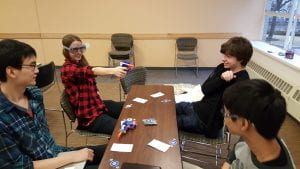
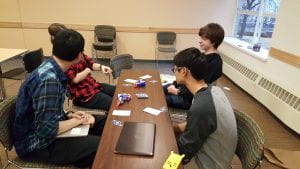
This version of the game is wholly very similar to the original game that I put out, but that’s because I was really happy with what I wound up creating. What I did change were some of the rules, adding a few more factors into how the game can evolve during play. I really liked the idea of games like Werewolf or Mafia where there’s the aspect of blind play and guesswork involved, as well as intuition and just raw luck. So, I wanted to create a more kinetic and physical version of that involving some of the objects laying around my room. From finding my old nerf guns to figuring out a good way to use a deck of cards, I was immediately drawn to warfare and decided that I wanted to adapt that in a fun way while also trying to use the Dada views of conflict. What happened was that I wound up with a game where every round a room of diplomats are trying to figure out alliances with everyone in the room before having a frantic shootout with whomever they think are their enemies. I think that my idea embraces the idea of Dadaism where ultimately most of the conflict players will be having will be ultimately futile because they’re always just as likely to kill an ally as they are their enemy and ultimately the best way to play the game is to always agree at the start to reveal who everyone is.


Artwork 2

Relaxing Fishing Game


Materials-

-Game download PC: Game File

-Game download MAC: Game File


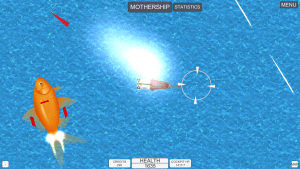
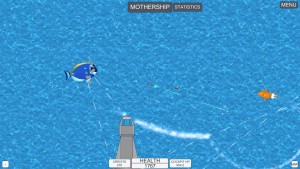
-Enjoy the relaxing game by blasting the space fish with lasers and cannons.

-Build your ship by selecting the parts from the menu.

-Launch your ship

-Use the mouse to point your ship and WASD to move forward, left, back and right.

RelaxingFishing

img

Artist Statement:

I made the original game that is used in this artwork. It was a game about fighting and shooting, high intensity. I wanted to make an argument with this by adding elements that would normally be relaxing or peaceful. I picked fish, and Sonatina Op 36 No 6.

The fish replace the normal enemies, so as a player you control a space fighter ship with the job of destroying these fish. While doing this the player listens to a very relaxing and wonderfully constructed piece of music.

712

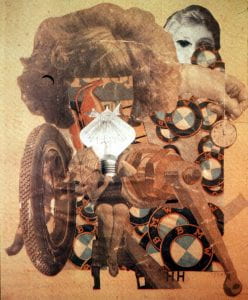
-Hannah Höch

I found art from the Dada movement that focused on the futility of conflict and made statements by creating satirical artworks that pointed out the issues with ongoing conflicts to be especially inspiring with the direction I took for this game.

artwork 2 final

Merchant and Thief

rip a page from your school book

36ae772d607d03f5d31689b2215b27

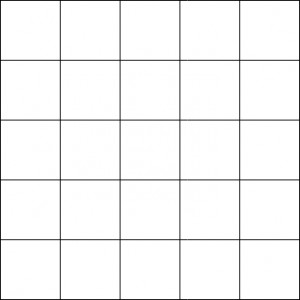
Draw a 5×5 square grid as indicated prior

place five pen caps at each  end of said grid, the two caps on the  extremities need to be identical, one side will be the Thieves and one side will be the Merchant and Guards.

the five pieces will be explained:

Either move or Ranged attack

-The Archers 2hp: are situated on the extremities of each team, they can attack anything in a diagonal path but only cause 1 damage( every character only has 2hp) they move 1 square per turn.

– Shield master 2hp: Left of the king, he is the only character who can block arrows

– Great sword 3hp: on the right of the king, if damaged he attacks anything in a 1 square radius of him

Merchants:

-Merchant (king): moves 1 square per turn, can spawn a recruit every 2 turns (recruits are 1hp and only 1 square movement for 2 turns then choose what they become)

Thieves:

-King of thieves 2h: the king is the central cap on the board, he can move anywhere in a 3 space radius from him and if he doesn’t move when dealt damage at first exchange him for an archer on your team.

The reasons why i choose to make a game such as this because I feel like chess is a very timeless thing, there were some great chess champions at the time as well. The other reasons are that to play this game you are destroying a dada textbook( I think it would make some dada artists really happy). And thirdly i feel like making people make the game board and find the peases also resembles what Dadaists were trying to do


Artwork 2: Appropriation-Final Iteration

Final Iteration for Artwork 2

An Arena For High Stakes Chess

Starting Materials:

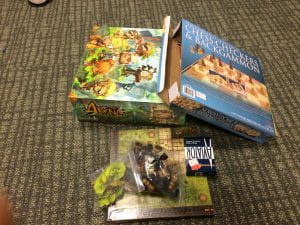
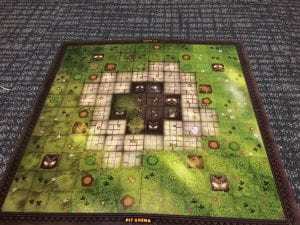
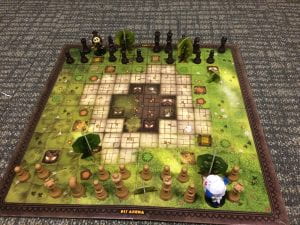
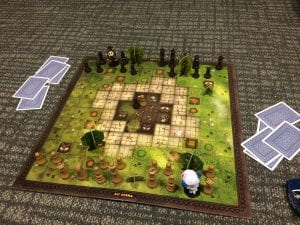
  • Arena board, from the game Krosmaster Arena
  • Chess set
  • Deck of 52 playing cards

Rules:

Players play rock paper scissors to see who goes first, that winner may choose black or white, it doesn’t matter.

Players then set-up the board;

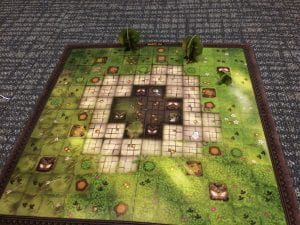
This is done by first placing down obstacles for the opposing player,

This is done by using the Arena accessories such as trees, crate, and bushes.

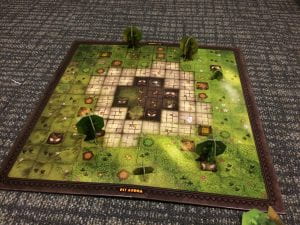
The player who lost the rock, paper, scissors game may set down up to 5 pieces(3 trees, 1 bush, 1 crate)  in any spot that he/she wishes first. Then the other player does the same.

Then both players setup the board as they would in regular chess,

The players must stay in the first two rows on their side, but they can as be spread out as they want, there are “12” spots, for 8 pieces per row, so there will be space.

The two kings must be facing each other, and must have a pawn in front of them. (this is to prevent the king from being taken immediately).

The rest is set up in the standard order

Once set up the players can start the game.

Changes to the Chess Rules:

All pieces that had restricted movement can now move an extra space if they wish,

(this is for pawn, king, and knight)   

Pawns can now also start by moving  up to 4 spaces forward on their first move if they so choose to.

If there is an obstacle in the way, the piece can move around it by making adjacent steps around the obstacle.

Knights can choose to move up to the 4 steps they can make, meaning they can move less than 4 steps, but they always have to move at right angles.

Knights can now also jump over crates and bushes.

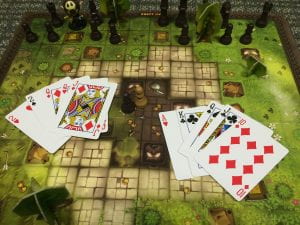
When capturing an opponent’s piece, the players must play a round of 5 card poker.

This means both players draw 5 cards, and the anti is the 2 pieces that are “fighting” each other. As in 5 card poker, each player can exchange up to 5 cards with the “dealer”. The dealer can be designated through whatever means. The player who does the “attacking” gets to exchange cards first. The player with the better hand,  keeps their piece in the spot, and the losers piece is “taken” or discarded.

Then play continues as normal.

Checks, or checkmates, are played the same way, if the king is being checked, and the player doing the checking has the better hand, then the king is lost, and the other player wins.

The rest of the game is played regularly.

Documentation:

Materials:

IMG_6105

The board:

IMG_6106

The first player setting up the obstacles on the opposing side:

IMG_6107

The second player setting up obstacles:

IMG_6108

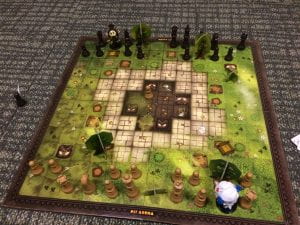
The pieces are set up:

IMG_6109

An example of an attack, white pawn taking black:

IMG_6110

After cards are distributed and exchanged the winner is decided:

IMG_6111

White has taken the black pawn, and now it is the black sides turn:

IMG_6112

These are a few shots of gameplay in class:

Annie making a moveIMG_6113

Manning’s turn, taking  time to think it through

IMG_6114

5-Card poker, gamble over their pieces

IMG_6115

The hands are shown, higher hand wins

IMG_6116

Artist Statement:

This piece was inspired by several different artists of the Fluxus movement. The main inspiration is of course Marcel Duchamp, who worked so much with chess, that he eventually became a chess master. The piece he made with Johnny Cage, called Reunion contributed somewhat, as well as Yoko Ono’s White Chess. The Fluxchess sets were different and aspired to make the player feel something new, to create a sense of flux in something that had existed for hundreds of years if not more. For my piece, I wanted to emulate war, and at the same time, the randomness of life. I wanted my chess board to represent a battlefield, a place where soldiers fight each other, often for a pointless cause. I wanted the reality of life, which is represented by the “randomly” placed obstacles, to be present in the game. And I wanted each encounter to be decided by chance and just a hint of strategy, much like the wars that have persisted throughout humanity’s history. This ties in with the larger board, a 12×12 , because of how in real life wars have been fought by large battalions and hundreds of thousands of people have died. A simple 8×8 board is too small to emulate such battlefields. The obstacles that are placed by the opposing player can be seen as “fate” or “luck” and can simulate how our lives are shaped by the obstacles around us. I also quite enjoyed the grassy aesthetic of the board, and think that it is more interesting than a simple grid pattern. My overall goal was to create an aggressive, quick game, that is often decided by chance. This is quite different that Yoko Ono’s White Chess in which the players must be focused and play slow to keep track of who is who.  I think the amalgam of the games that are presented works well and creates a fun piece of art and a fun game.