Projects

Artwork #4: Experience Final

When you’re living with anxiety, there are times when it feels as if everything is just a second away from crashing down around your ears. You feel as if you have to put dozens of safeguards in place and quadruple check everything so that things don’t fall apart. This is the sort of feeling that I wanted to get across with my game.

There are already plenty of games that make the player feel anxious, but there aren’t many that I’ve found that include the other major aspect of my game. From the very beginning,  I wanted each player to reach a point where they would realize that all of the things that they were preparing for would likely never happen to them, and that they were trying to protect themselves from nothing.
15409578_1215463621833403_1396621937_o

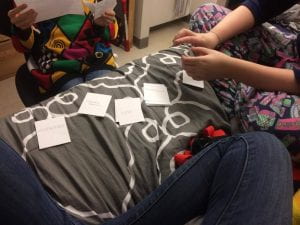
The first iteration of my game was played as follows: each player got a hand of 5-7 Preparation cards (depending on the number of players, from 2-4) and one Critical Events card. The Critical Events card had two events listed on it, and under each event was a list of two preparations. The players were told that if one of those events came up and they were not prepared for it, they would have to draw until they had the necessary cards. The ultimate goal was to discard every card in their hand.

Each round, each player would draw a Preparation card and have the option to either discard two cards or trade one card with another player. At the end of the round, an Event card would be turned over. The players would make sure that the event was not one off their Critical Events cards, nothing would happen. The goal of this ruleset was to encourage players to horde Preparation cards out of fear of an event coming up that they weren’t prepared for, and then to slowly come to the conclusion that they don’t need to prepare for all of these awful things that would never happen.

This version of the game had both positives and negatives. On the positive side, I had a very simple set of mechanics that generally got people to the conclusion that I wanted them to reach. On the less positive side, the game was not engaging enough to make people feel anxious about losing, which somewhat undermined the effectiveness of it.

The second version of the game was based on the advice I got from some of my playtesters. Each Critical Events card has two events on it, and so I created Event cards for one event from each Critical Event card. I also added Perparation cards that were related to the Event cards that were already in the deck (but didn’t put new events on any of the Critical Event cards). This version worked better as a game, but it failed to get across the same point as the first iteration.

The third iteration of this game is the one that I’m the most excited for. I added several cards into the Event deck that made certain players (the one with the least cards in their hand or the players without a certain Preparation card, for example) draw extra preparation cards. This way, the outcome of the game is not predetermined and the players feel like they have some agency over the outcome. I also removed the new Event cards.

This is the version that I am most happy with, because it keeps the original concept while making the game feel more engaging. It isn’t perfect, and going forward, I would like to continue to work on this to add more to the second phase of the game, where the players realize that the Critical Events aren’t in the Event deck. At the moment, the game is very shallow and doesn’t offer good answers for those looking for ways of coping with anxiety.

When creating this piece, I believe I was most heavily influenced by Yoko Ono’s scores. There are are many of them that purposefully make the participants uncomfortable. The scores aren’t necessarily enjoyable, but they make a strong point, which is something that I hope I have accomplished or will eventually be able to accomplish with this game. I also somewhat had projects like Tekken Torture Tournament in mind while working on this, as games like those don’t just depict something (in that case the much simpler sensation of pain), but actively make the player feel it, such as how my game aims to not just show the player what happens in my mind during high anxiety days, but also make them feel the uncertainty and stress.

This is one of the two pieces in this class that I am most proud of, the other being my crane piece. Unlike the other pieces I made for this class, I feel that these had strong central mechanics and a distinct end goal, and to various extents, I believe that they were successful. Working on these projects also made me think about game design in a very different way than I am used to. Instead of starting with a story and fitting mechanics to it, these works have a central mechanic that is in itself almost a narrative element. This streamlining, more than anything, is what I am happy to have gotten out of this course and what I hope to continue to incorporate in my work in the future.
Cyber Demon

Available to play here!

screen-shot-2016-12-07-at-12-54-06-pm screen-shot-2016-12-07-at-12-54-45-pm

Throughout the course of the semester, I was taught many different methods of art expression and how they’ve impacted us years later. It is because of this that I was able to grow as an aspiring game designer. I really appreciated the fact that we were able to work with different mediums in order to convey our own unique messages.

That being said, playing around with different mediums helped me to develop my own aesthetic and to figure out what type of games I truly enjoyed creating: therapeutic and uplifting games, which I found interesting since my favorite genres of games tend to lean more toward violence. I really enjoy making others smile, and through games, I found that I could also express that.

For this piece in particular, I decided to focus on two topics I hadn’t really touched upon in the past: trust and deception. While keeping these in mind, I also tried to incorporate therapeutic themes into the piece.

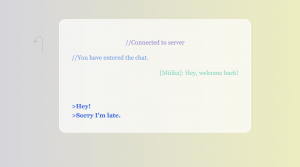
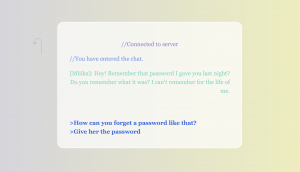
In my initial playtest, the player was thrown into a chatroom with an anonymous user. They were then given the option to either make normal conversation with the other player or to pry into their personal life and determine who was on the other side.  The goal was to build up a level of trust with the AI in order for them to open up to you.

After playtesting, I realized that the original goal of the game seemed a bit lost, so I decided to make some changes and switch it around.  Now, the user enters the chat with who they think is an online friend. The narration describes how the two of you have been talking for awhile and have established a foundation of trust. Later in the game, however, you encounter a demon that disguises themselves as your best friend. Based upon their actions and narrative, it is your job to determine who is actually behind the text and to determine who it is that you trust. Previously, the idea was that the other user was trying to open up to you, but I felt as though it would be more powerful if the game took place from your own perspective.

During the beginning of the class, I really took a liking to Yoko Ono’s pieces and the interaction that was provoked from her work. Although some of them seemed silly, I found most of them to be rather therapeutic, and thus I took inspiration from Yoko’s work.

I also enjoyed seeing my peers develop their own individual styles and to see how this impacted their final projects at the end of the semester. Seeing other takes and perspectives on projects really helped to further develop my game design skills, and I believe it will be a very useful tool later on in the workplace and other aspects of life.  I do wish we had more opportunities, as peers, to collaborate with one another on projects, as this could’ve been both useful and intuitive.

In the end, I thoroughly enjoyed this class and felt as though I had learned a lot. I’ve met many amazing and talented people throughout the semester who have also helped me to grow. I would highly recommend this course to future game designers, but also to any other students wishing to grow and to develop their own styles.

Continue

rar file: https://www.dropbox.com/sh/an55072uco95nex/AAAGMbK6W192Z5rR8rmKbbQ5a?dl=0

(all art, sounds, and music assets courtesy of the resources provided within RPG Maker XP)

Artist’s Statement:

This class has been an interesting experience for me. I’ve been in a game design class before, but this one made me really push the boundaries on what I thought a game was. It also gave me new perspectives on what I could do with games. Our first project in scores was really what sold me on this.

I loved the healing aspect of Yoko Ono’s work, so I tried to go back to that and work it into my final project. In the game, the player starts off alone with no support. They are easily defeated by the boss – one hit, before they even get the chance to attack. But, the more they play, the more members of their former team rejoin and the stronger they get. I wanted the player to feel more empowered and hopeful as they continued to fight an initially futile battle.

This is also a similar sentiment found in the game I wanted to bring in for the indie game show and tell – Undertale. Unfortunately, I was absent on the actual day, but I wanted to go over the theme of friendship in the game. As the player goes on, they accumulate more friends that help them throughout the course of the game, a few of whom are set on destroying the player when they first meet. But through determination and a will to get through to these characters, the player is able to gain their support. I’m the type of person that relies on the presence of friends and family to make it through tough times, so I found this message incredibly touching knew that I wanted to make games that also had similar uplifting themes.

On that note, this class has also helped me realize the kinds of game that I want to make. I like making games that help make people happier or bring people together to have fun as a group (such as the game that I hosted for the third project). I feel as though a lot of art games like to deal with heavier themes that make you think. And I certainly don’t think that’s a bad thing – in fact, I think they’re important and should be made. But personally, I think I want to continue making games with a more light hearted sort of vibe. I don’t think I’ll steer entirely away from darker or more somber themes, but I’d like to incorporate them into a more uplifting message rather than making them the sole focus (I’m always a sucker for a happy ending, after all).

…and I think that’s about all I have to say in regards to the game. As for the class, I think it’s helped me figure out more about my own personal preferences by exposing me to different types of art. I also got a chance to mess around a bit and try out things in different mediums that I normally wouldn’t have thought to use. I think, in the future, I’ll continue to try and explore all the possibilities that I can.

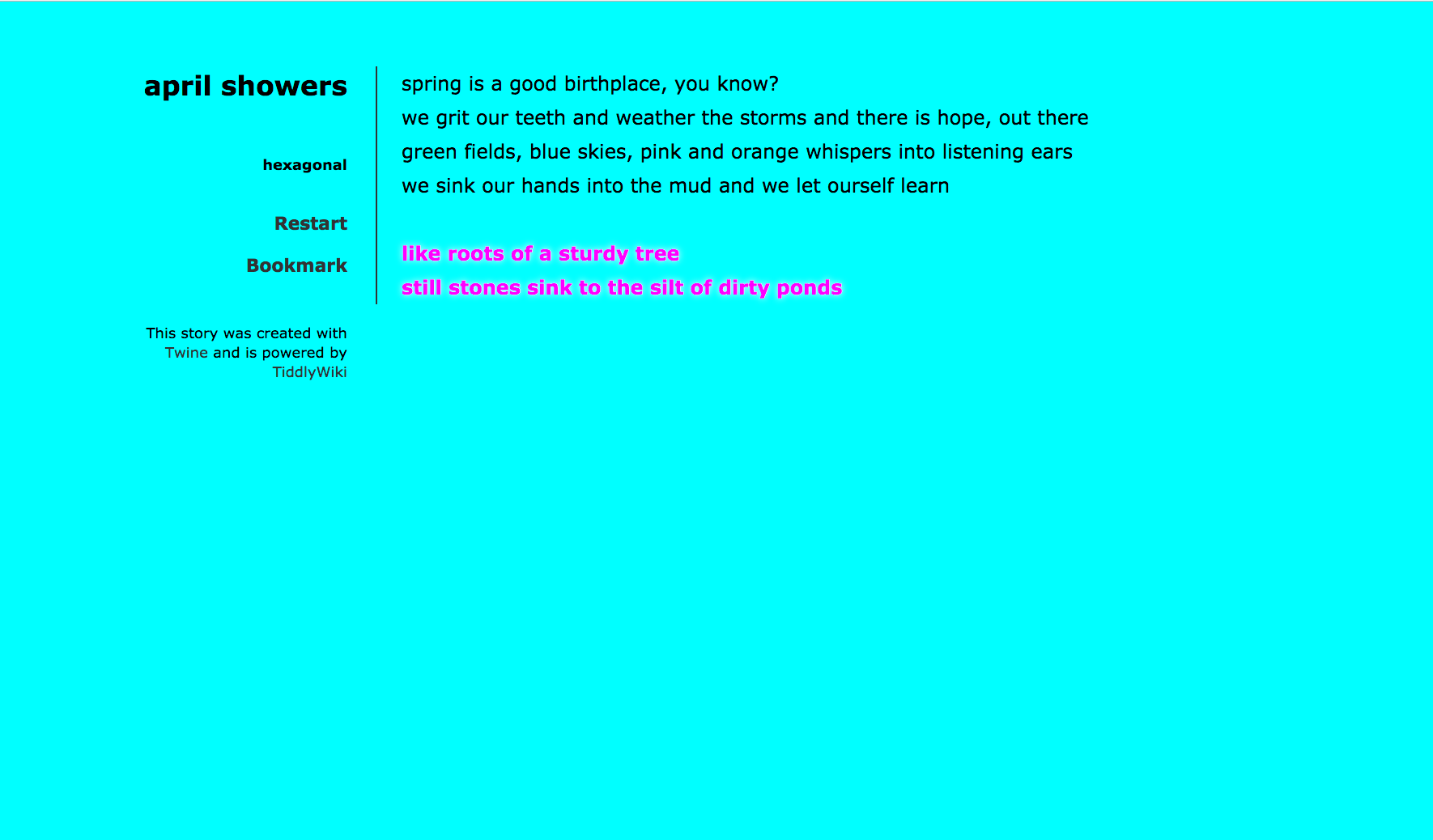
april showers

Game:

first page of spring

first page of spring

http://www.philome.la/hexag0nal/april-showers-prototype


Artist’s Statement:

This game was the culmination of a lot of things. I think it has been in me for a very long time, but this class gave me the means and the confidence and the drive to create it.

Unavoidably, I was inspired by Porpentine Charity Heartscape – she has written so much interactive fiction that has changed my life and the way I view games in general. In particular, I had in mind “Their Angelical Understanding”. When I first played through it, I almost had a panic attack, because though the experiences were not mine, would never be mine, I felt the depth of the person behind the words and saw some of me in them as well. I wanted to make something like that. Another outside influence would have to be “Queers in Love at the End of the World” by Anna Anthropy, an interactive fiction game that lasts only ten seconds. It really overwhelmed me with a sense of possibility. Though I did not want something limited by time, I wanted something that could seem almost endless in possibilities and always ongoing. april showers ended up having 40 different ending cards.

From class though, I was greatly inspired by, as has held true ever since the first “unit”, Fluxus – and Yoko Ono in particular. The idea of art as an experience and experience as art really resonated with me. april showers turns my experiences into a game and hopefully what could be considered art. The pieces within Grapefruit felt deeply personal and sometimes almost nonsensical, which is, honestly, a style I love, like a secret you can only think you understand. Some of them also felt deeply cathartic, and I think catharsis through creation can be the cause behind a lot of great things. Making my own game certainly was cathartic in a lot of ways. There were also a lot of Dada works that inspired me – the aesthetic just did something for me. I think the sort of collage feel of many of the works definitely made me want to put together a narrative made out of scrambled bits and pieces. A word collage, I guess!

Reading through Schrank’s book, though I don’t think it did all that much to the development of my game, did help me focus my thoughts. Though obviously not a perfect structure, I concluded where my game lay on the graph and also where I wanted it to lay, which definitely affected my thought process for the rest of the writing. I knew that due to my own personal tastes, I would end up with a game that would be considered by the general populace as “radical”, but I definitely wanted to make a reflexive game with what could be interpreted as political undertones.

This class inspired me in a lot of ways. I’ve always loved games, but just getting the chance to talk about them more and think about them more and interact with people about the design of them more motivated me to push myself even further. This semester, I’ve played a lot of games off of itch.io. Some of them weren’t that great, some of them were practically unheard of even by indie fans, some of them satisfied an itch inside of me that I didn’t know was there. I spent a lot more time going through interactive fiction lists and the archive, and that especially gave me an idea of what exactly I wanted out of a twine game, an interactive fiction experience.

All I really want my style to be is to be creating games with a lot of heart in them, which I hope I have been achieving!

Artwork#4 Self-Intro

Game Description:

This is a text-based narrating game, there are 2 players, player 1 first answer a series of questions, and his/her answer will be the only   choices for player 2, who must fill in the blanks from sentences popping up on the screen, the “story” is about a person who is introducing himself.

capture

capture2

capture3


Artist Statement:

So the idea of this is that I want 2 players have 2 opposite feelings of the game, player 1, who is just answering the questions, will have free choices of answering all the questions, however for player 2, his only choices are provided by player 1, who just filled in those questions arbitrarily. (Note: player 1 won’t be told the fact that player 2’s choice was based on what player 1 filled, the game just asks player 1 to answer whatever he/she likes, and telling that will “help” player 2.)

More about the experience, I want the player 2 to feel that all the choices are totally dependent, frustration and struggle are what I am aiming for in this piece.

Inspiration & Iteration process:

Throughout the semester, I had been interrogating myself the same question again and again, that is, what is “experimental game”, well it seems easy to answer but I was struggled to find my own answer to this. I find it difficult for me to come out with an idea that can be approved by myself when I’m thinking of making a game just focuses on a certain aspect. For this project, at the beginning I started with the idea “I want to create a text-based game which player don’t make choices but write their own.” And apparently, it turns out someone had already done that before. But one thing I learned from that is I must make my goal more specific, more extreme, and with more strict design limitations, that is how I came out with this final version.

In the final version, I want player 2 to be frustrated and struggle to choose the word, additionally why I choose the story to be a self-introduction of a person is I think the answers player 1 answers, when they become choices for player 2 writing a self-introduction, it feels like player 1 is creating a “standard” for the character, I want to criticize the aspect that the standards created by other people may limits who you could became.

The first iteration was pretty frustrating for me because when I found out the ideas I came out had already been done, however I think it does happen a lot and it’s a good lesion for me, especially it gives me the chance to re-think about my ideas and make it more unique than before. It is also pretty much my overall learning experience/understanding throughout all 4 projects, that finding the way to make your idea expressive and unique.


RPG final artwork #4: Experience

first, I have to say Xiao is wrong, he is not the only business major in this class.(´・ω・`)

RPG

artist statement:
For the final, I want to make a digital game, I like digital games, making a own digital game is one of my dream in my middle,
I learned RPG Maker and joined a group at that time, however, unluckily I don’t have enough time to make one, so I had to give up.
my idea of this game is to create a mainstream game, this is the reason why I select this class,
after a semester’s class, we talked about Fluxus and DADA, try to thinking and learning in a different way,
abandon our regular thoughts and try something totally new so I start to think about looking at normal game
in different angle.
Another reason is Yuusha Yoshihiko, a Japanese Drama, this drama talks about warriors save the world, in the drama,
they fight like in turn-based game, also like normal they will enter citizen’s house and search for items. When a Drama
act 100% as a RPG game, you will find there are lots of irrational things happened. So I think I can put this kind of
event in my game to make it more reality.
I think this is the main idea why I want to create a normal RPG game but you can also jump out of the circle,
to redefine the game.
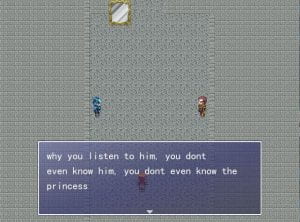
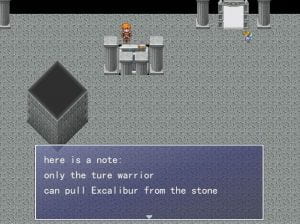
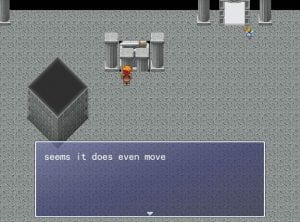
So basically my game is talking about a normal RPG story, princess was caught by demon, our character’s job is to defeat
the demon and save the princess. However, not everyone is the chosen one, you might die in half way, even if you
finally reach the boss room, you might still can not win. Because why a human being’s power can win a demon in a single
fight.

game testing:
My game testers are my roommates, they thought the whole idea is very good, some times they also have same
questions when they play RPG games, why they can break into others house, why they can be blocked by a small tree.
However, they think the plot and maps are a little too weak, sometimes they do not even know what to do next, and
there is no battle fight in the game, so there is a little boring when they are walking from a map to another.

1234


rpg here is the link

Lèse-Majestè

Rules:

It’s a dangerous world out there. Injustices and inequalities have led to a never-ending global warfare. Ironically, the only place that is safe is the prison.  For the sake of your own survival, you must try your best to make your way into the prison.

  1. Select two players to play the game and another moderator — total of 3
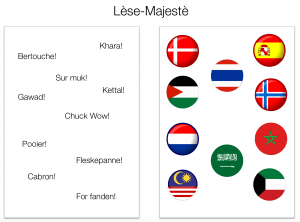
  2. Each is given a set of two cards, one with 10 different country flags, and another with 10 curse words from the respective countries (the words are jumbled up)
  3. Ask two players to engage in a meaningless back and forth argument for 60 seconds
  4. Moderator will determine who was winning the argument and that player will be the one to go first
  5. Player 1 will choose one of the 10 curse words to swear at Player 2
  6. Player 2 responds “where is that coming from?”
  7. Player 1 must attempt to guess which country the swear word is from and
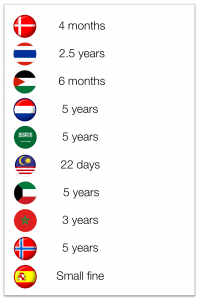
    1. If correct, the moderator will cross off the word and country and the player will have earned the according prison sentence.
    2. If incorrect the turn ends and the other player may reuse the word and country.
  8. It’s now Player 2’s turn and repeat steps 5 – 7.
  9. Repeat step 8 until all words and countries have been crossed off.
  10. Tally up each player’s sentence and the player with the longer sentence wins the game.

Player cards

lese-majeste

Prison sentences

punishment

Artist Statement:

This was definitely the topic that I was looking forward to the most during this class. I have always been very interested in using seemingly very simple games or puzzles to reflect on a message. I think one of the biggest topics of 2016 has been the US presidential election, which is why I decided to pursue a very political piece.

The year has been a strange one, with President-elect Trump, in particular standing out as one of the most distinctive and usual candidates the country has witnessed. For the people who support him, he is the strong figure that will “make America great again.” For his protestors, he is disrespectful and “unpresidential.”

Other major concerns are the potential risks and unrest that Trump’s win may cause for the rest of the world; given that Trump has made multiple promises to drastically shift the terms of alliances and relationships with the world.

So I thought to myself, what if the worst happened, and nowhere in the world could be considered a safe place? What if in this world, in order to survive, one must be radical and occasionally offensive just to survive? What would an experience like this feel?

I must admit that I’m not an avid player of any games, whether it’s indie games or video games. I didn’t have a lot of previous experience to draw upon, but I was very inspired by our 2nd guest lecturer’s games that we play tested. In particular, her game/puzzle with linking ingredients to making drinks and leading to word combinations was very interesting. The notion of taking the unknown and delivering a pleasant surprise was very inspiring to me. I decided to take a similar format and turn it into a 2 player game as I thought curse words require a subject and also an emotional investment.

Class thoughts:

For me personally, as a graduating student this December, this was one the most interesting electives I have taken in my time at Northeastern. If I’m not mistaken, I am the only Business Major in the class.

I came into the class very worried about the art or computer science skills that may have been required or expected. However, I was very pleasantly surprised to find that this class has “no right answer.” All of our projects have been about interpretation, which allowed me to be very creative in a way that my usual business classes don’t encourage.

From the Score to the Appropriation, and to the Intervention; I thought that I tackled each project with more confidence and knowledge. Overall, I’m very proud of my own learning outcomes in the class and I will definitely spread the word among my business classmates that are looking for electives!

3xdiarykind

Play my game here:

http://www.philome.la/10itemsorlex/3xdiarykind—never-grow-up

game2 gam1


3xdiarykind is an interactive fiction game where you get the chance to actively explore three diaries– they happen to be mine, kept from 5th grade until my senior year of high school. The design is simple on purpose. It is not supposed to be flashy or anything– it should mimic the simplicity of the books they are based on.

The formatting of the name is taken from Homestuck, a webcomic that sustained me during my most difficult years. Humorously enough, you can actually see my attitude towards Homestuck change throughout the course of the game.

Additionally, 3xdiarykind makes numerous references to other video games. This is a testament to my love of video games, & one of the most oddly charming parts of the game, I think.

My game is meant to serve as a commentary on mental illness, & I think it’s unique in that the experiences described are the real, genuine experiences of a neurodivergent child ~> young adult. They are not fabricated in the slightest– every single word you see in quotations is taken directly from my diary. I’m very interested in games about mental health, or games that at least explore those themes, such as Depression Quest. Mental illness is sort of a tricky topic to navigate, however, because as much as I want it to become normalized, I don’t want it to become trivialized. Mental illness isn’t a cute little quirk we can slap on to any old character & call it a day– it’s complex, & treating it like it’s not is frankly disrespectful to those of us who live with a mental illness.

Additionally, my game explores themes of growing up, or, more accurately, refusing to grow up. Of course this theme is natural– it wasn’t intentional, it simply exists because my diaries perpetuate it. It’s simultaneously interesting & cringeworthy for me, being both the author of the game & the author of the diaries from which the content is taken from. I hope it provides a little amusement, & distracts from the rest of the game.

When I set out to create this game, my initial idea was quite different. I wanted to use my diary in some way,  but I wasn’t sure how. It was actually Hex who inspired me to really check out interactive fiction,  & their game suggestions convinced me that IF would be the most successful way of conveying my story. That’s really all my game is. It’s a story of a girl who knew something was wrong, who documented it, who wanted to feel differently, but who didn’t know what to do.

My playtesters (my friends, predominantly) said that this game was extremely difficult to get through because of the subject matter. They had an especially difficult time because they know me, they care deeply about me, & it’s difficult to imagine a close friend suffering. I hope that other players will be able to experience it with a little less difficulty. It is not my goal to make people upset…in fact, I didn’t stop to think about how empathetic players may feel terribly sad while playing this game. Instead, I wanted to simply raise awareness about mental illness, especially in children. After all, I am a well adjusted, high-functioning young adult now, thanks to years of cognitive behavioral therapy. This game is a somewhat cautionary tale I suppose, but even that is not exactly accurate.

This game is a culmination of everything I want to do in games. This year, the games I was most proud of were the ones that dealt with deeper themes– in this case, my first Balloon Piece. I was fairly dissatisfied with my word game & my stealth game, simply because they felt pointless to me. I want to make things that matter, or things that are autobiographical in nature. I’m thankful that this class gave me that opportunity. I’m only upset that I did not make four games that capture my values.

I hope this final piece makes up for all of that.

The scope may be small but it’s also vast. It’s seven plus years of my life. I hope you find some meaning in it.

Artwork #4: It’s A Feature & Class Summation

Artist’s Statement

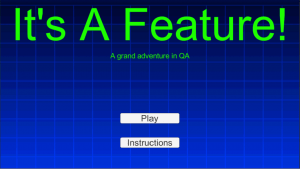
When coming up with an idea for a final project, I knew I wanted to do something digital, but I couldn’t think of a unique enough concept that would be feasible in the time I had with the skills I possessed. I eventually narrowed it down to either a game that utilizes cheat codes, or a game that used music input for controls. I decided on using the cheat code idea as that was the most developed of the two. As I started work on the project, I wonder what narrative possibilities there could be for this type of game and how I could spin the gameplay around such a narrative. QA testing was a quick idea stemming from my experiences on co-op and in other projects, so I tweaked the idea to make it a story about a newly hired QA tester dealing with a poorly made, unfinished product. Thus, the concept of It’s A Feature was born.

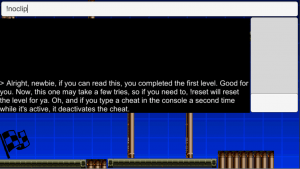
Inspiration for this project came from a combination of personal experience, previous works and material from this class. The material that I believe is related to this project is the Dada movement, which had a series of works that turned their respective media on their heads, while also focusing on the audience experience. My game is made to serve as a statement on the frustrations of QA and Bug Fixing, so I intentionally made it as tedious and inefficient as possible. However, I still wanted the game to feel like a game, with a goal and unique gameplay  that maintained the line of challenging and entertaining, similar to how Dadaists maintained some tropes of their media while keeping up their avant-garde style, so I made sure not to go to overboard and provide sufficient tutorial in the console UI for players on any end of the learning curve. The reason I chose a developer’s console format for this game stemmed from my frequent playing and streaming of Garry’s Mod on PC. In GMod, players use a developer’s console to enter cheats such as flight, no collisions, killing all other players, launching nukes, among many other surreal features. I figured the console would be a simple enough format for gamers and designers like me and my classmates to pick up on, and sure enough, they managed to pick up on the system with very little assistance. Non-gaming inclined players might take a bit longer to grasp the system, but that’s why the tutorial is so descriptive.

Playtesting for this game occurred over several instances in two different classes. Overall, the game was very successful in bringing about intense frustration in the player, as the first couple of playtesters swore and screamed many times over the course of the game. Despite the frustration, they still said the game was fun and I had a clear and well-executed message.  One complaint some playtesters had was that some of the UI needed to be tweaked in early iterations, specifically in the mock developer console, in order ton make the experience a little more realistic (i. e. Getting rid of inefficient buttons that could be replaced with a key press, and switching around some key commands to pertain to certain), but that was easily fixed in the more recent iteration.

Documentation:

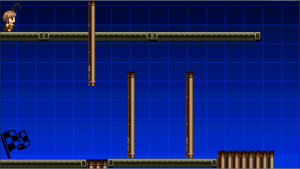
game1850-01 game1850-02 game1850-03

Click below for .exe file:

its_a_feature

This Class’s Effect On Me


The materials offered in this course on Dadaism, Kaprow Happenings, Andy Warhol, Yoko Ono, The Institute etc. focused a great deal on Human Experience, and they seem to have had a great effect on me during the course. All of my major projects had something to do with re-experiencing events with a modified perspective, and managed to cover various mediums of artwork instead of just the digital games I had become accustomed to working with.

My First Project took a simple, everyday action, eating a meal, and turned it into a music theory experience. It brought to light how little we think about mundane actions, and the psychological presence of music all around us. I found it to be a fascinating score, despite it’s non-game feel, and it opened up my prior inhibitions about any other experimental works in the class.

My Second Project, a more game-like one, doubled as an analysis of vernacular and tradition in gaming communities as well as a creative mod of a popular title. It helped me realize the hidden depths possible in a game that appropriated so many assets and mechanics, so long as they are executed properly and well-explained in any write-ups.

My Third Project, while a failure, was still ambitious in its concept and did manage to teach me something about development and human behavior. It was an ambitious guidance system that tried to drag people out of their comfort zone in public, as this class had done to me a couple of times. However, I didn’t manage my scope hard enough, and I didn’t take into account people’s willingness for public performance, and I couldn’t garner support for a playtest. Now, I have learned from that mistake and used the lesson learned in other projects this semester.

My Fourth Project is gone into detail above, and it was subjectively one of my better works this semester. I think I have greatly grown as a designer thanks to this course, with the materials, assignments, and other activities providing many new ideas to expand my scope for brainstorming and developing concepts. I am grateful for all the offerings this course had to help me grow and prepare for the field of game design, and hopefully I can continue to apply this acquired skills in future courses/assignments/projects/positions.

Thank you and good night.

Experimental Anxiety


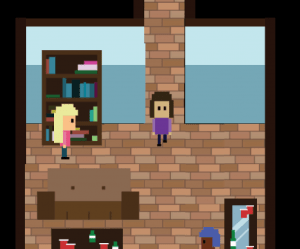
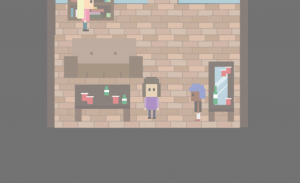
gamecapture1 gamecapture2

The main theme behind my final game is anxiety, hence the name ‘Experimental Anxiety.’ There are some moments in which there are too many people around me and the rise in temperature, due to body heat, and the lesser amount of space cause me to have a mild anxiety attack. I wanted to show what anxiety feels like to those who may not experience it in a way that communicates the symptoms fairly simply.

I got my ideas from a few different concepts we’ve looked into during the course of the semester. Two of the main games that I took inspiration from were Undertale and Akrasia. Undertale, mainly due to the art style and how the characters could fit many different types and players could connect themselves in a variety of ways. Akrasia due to the simple gameplay mechanic that told such a deep story. With only one scene change and the simple four direction movement and collection mechanics, the story of a drug addict was so beautifully told.

Throughout this semester, I have learned to look more closely at games for change and games that focus on more serious topics other than games that were meant as a source of entertainment. Experimental Game Design, Games Interface Design, and Rapid Idea Prototyping have really shown me what it means to get an idea and an emotion across in a game whether it be digital or analog, and I have been extremely lucky to learn from such great women in the industry.

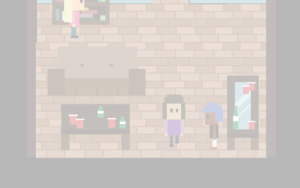
In Experimental Anxiety I wanted to use the simple story of walking around a house during a party, but have the main character start to experience anxiety. To simulate anxiety, I put a white box sprite over the game map and whenever the player got within a certain distance of another human sprite, the overlay opacity would begin to grown, thus obscuring the player’s vision. The only way for your screen to be completely clear is to get out of the house and away from all of the people.

Whenever my anxiety acts up, I experience a rise in body temperature and my vision begins to go white, and that is why I decided to make an overlay that becomes more dense.

This was actually my first time ever working with Unity and I am quite proud to show what I have accomplished with it. I have the mechanics down, however I would still like to iterate upon this game and try to make it more like what one of my anxiety attacks feels like. I’d like to add some some of pulsing animation with the overlay to show how intense anxiety can be and I’d also like to add more obstacles to the house so that it is not as easy to get out as it is right now.

I’m so grateful to have been a part of this class and for everything Celia has taught me. I liked learning about the art history that I haven’t looked into so deeply as I have during this class and I appreciate the abundance of knowledge.


experimentalanxiety